
Call the Council
Think the traffic is bad now? Just wait! The County Council is willing to add 13,000 vehicle trips a day. Add that to the 51,000 vehicle trips per day already approved with the Romney/ Lakeview Business Park, and that's a LOT of new traffic!
Tooele County is planning on passing Chapter 34- allowing Data Center Applications. We all need to SHOW UP on Oct. 7th (47 S Main Street - 3rd Floor) Your presence matters!
We will be in the back building at 6:30 to mingle and walk in together! Lets show up to make a difference!!


Are you concerned about Data Centers?
You Should Be!!!
TooeleCARES is FIGHTING back and you CAN too! What can YOU do to make your voice heard?
-
Contact the Tooele Valley Health Department and DEMAND an Environmental Impact Study
-
Phone- 435-277-2300
-
Email- eh@tooeleco.gov
-
-
Call your State Representative and express your concerns
-
Tooele and Stansbury Park - Nicholeen Peck
-
Phone- 801-834-5495
-
Email- npeck@le.utah.gov
-
-
Grantsville, Erda, Stockton, and Rush Valley- Bridger Bolinder
-
PH. 435-255-3093
-
Email- bbolinder@le.utah.gov
-
-
If you're unsure of who your representative is, Locate them here.
-
-
Attend the Meetings:
2nd & 4th Wednesday of every month
7:00 PM
47 S Main St. Tooele, 84074
Council Chambers, 3rd floor
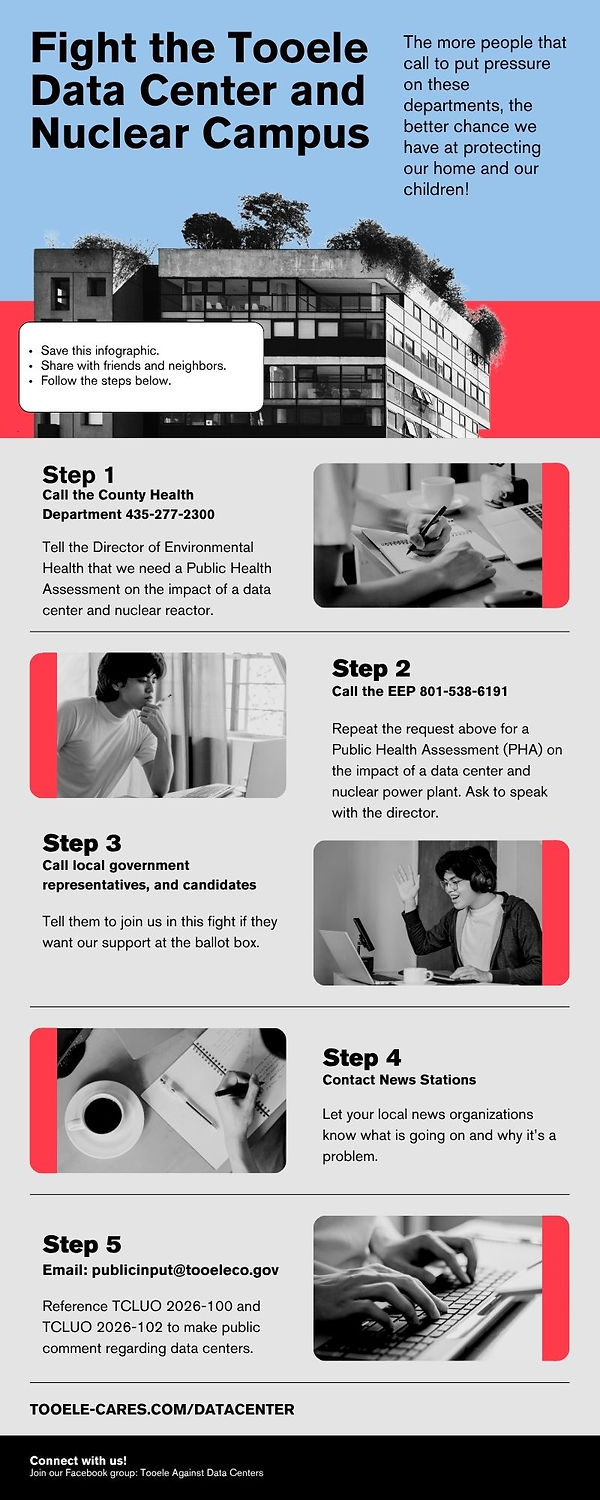
The Full Story- They don't want you to know!
Have you heard of the proposed $240 million taxpayer-backed infrastructure permit for an alleged data center in Tooele County? They want to discharge concentrated brine from a reverse osmosis water treatment plant into wetlands just 1.6 miles from Great Salt Lake (RIGHT IN OUR BACK YARD!) The discharge would flow directly into Gilbert Bay with no enforceable limits on salt, chloride, or arsenic.
A nuclear-powered AI data center presents a complex public health risk-benefit profile. Nuclear energy may reduce air pollution and greenhouse gas emissions compared with electricity generated from coal or natural gas. However, these benefits should not overshadow the potential negative effects experienced by nearby communities. A combined nuclear reactor and data center could place substantial pressure on local water supplies, increase noise and industrial activity, affect aquatic ecosystems through heat discharge, and create additional demands on roads, housing, emergency services, and healthcare systems. Communities may also experience chronic stress, anxiety about radiation or accidents, concerns about property values, and reduced trust in government or industry if planning and permitting decisions are not transparent. Although serious nuclear accidents are unlikely, their potential consequences require extensive emergency preparedness, evacuation planning, environmental monitoring, and long-term public health capacity.
The storage and transportation of radioactive waste also create responsibilities that may continue for generations. The public health burden may be greatest in rural, low-income, Tribal, or otherwise politically marginalized communities that have limited influence over siting decisions (location of facility). These populations may experience the water, land-use, noise, infrastructure, and perceived safety burdens while receiving relatively few long-term economic or health benefits. Therefore, the primary concern is not limited to radiation exposure alone. It includes the cumulative effect of water depletion, environmental disruption, occupational hazards, community stress, emergency preparedness requirements, and environmental injustice. Before approving such a development, decision-makers should require a comprehensive Health Impact Assessment (HIA), cumulative environmental risk assessment, independent water-use analysis, emergency response evaluation, and meaningful community participation. Without these protections, the development of nuclear-powered data centers could create substantial and long-lasting negative public health consequences, even when the reactor operates within established regulatory limits.
To learn more about the potential impact of a nuclear campus in Tooele County, click here.
Select below for more information on the negative impacts:
 |  |  |
|---|---|---|
 |  |  |
 |  |
References:
-
Gour, N., Ortiz, L., & Maibach, E. (2026). Health implications of the rapid rise of data centers in Virginia: An exploratory assessment. Frontiers in Climate, 8.
-
Han, Y., Wu, Z., Li, P., Wierman, A., & Ren, S. (2024). Health-Informed Computing: Estimating and Addressing the Public Health Impact of Data Centers
-
McLellan, F. (2026). AI data centres raise public health concerns. The Lancet, 407(10524), 119–120.
-
Mullany, A. (2026). The adverse health consequences of resource-extractive AI data centers: Analyzing technological innovation and rurality with university students. Radical Teacher, 133, 9–11
-
Tao, Y., & Gao, P. (2025). Global data center expansion and human health: A call for empirical research. Eco-Environment & Health, 4(3), 100157
Get Updates on Meetings and Actions
Join other Tooele County residents so we can STOP data centers TOGETHER!

